Some World Cup nights give you one storyline. This one gave us three, and every single one of them ended in an argument. Belgium somehow escaped Seattle with a spot in the last 16. Harry Kane dragged England out of an upset in Atlanta. And a USMNT red card in Santa Clara is still splitting opinion.
Living Belgium’s Great Escape From the Booth
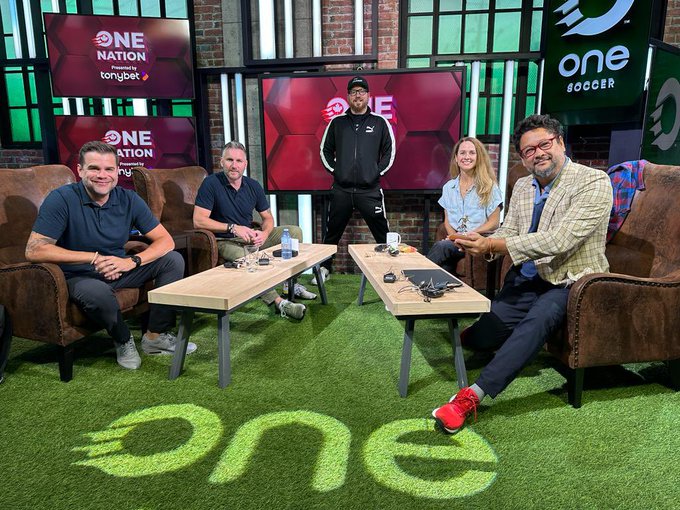
Craig called the Belgium-Senegal match for the FIFA international feed alongside Dave, which meant he watched Senegal’s near-miss unfold in real time rather than on a delay like the rest of us. His verdict on how good Senegal were for 85 minutes: the balance of that team was just about bang on, and even with Belgium showing some resilience, there was nothing in the run of play suggesting a turnaround was coming. Senegal had gone up through Habib Diarra and a brilliant individual finish from Ismaïla Sarr, and by his read, the game was simply drifting toward a famous African win.
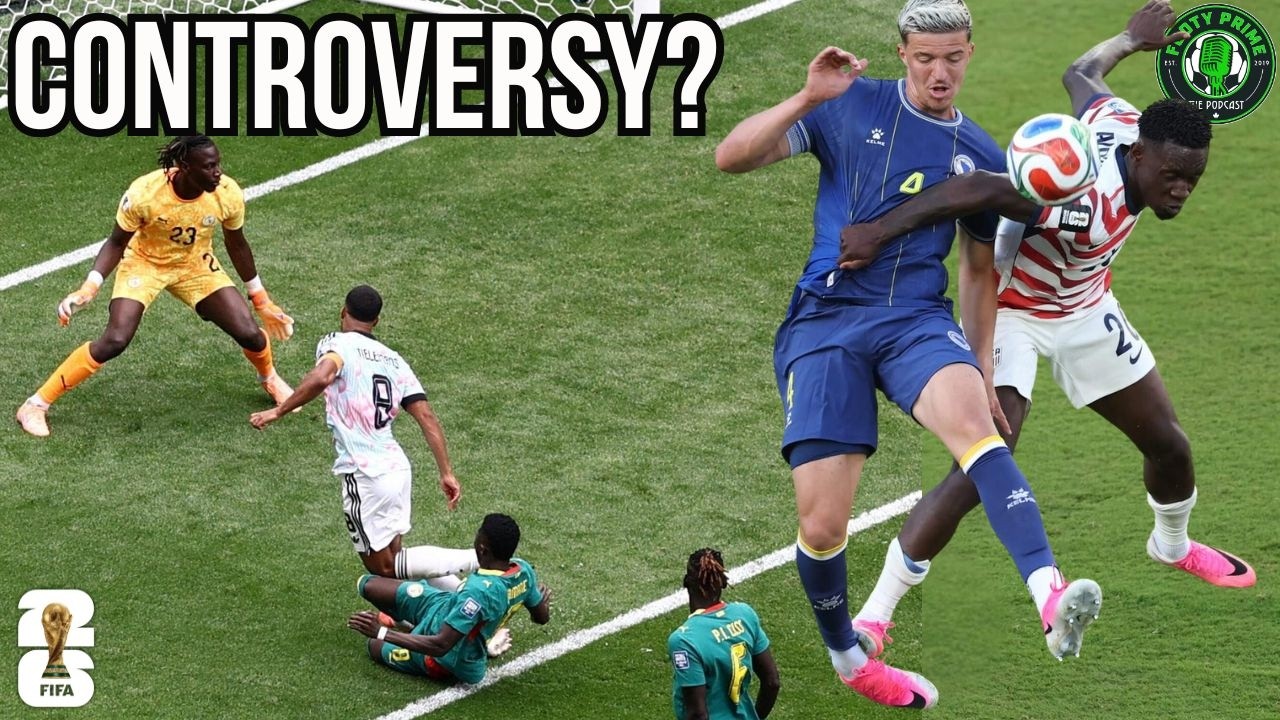
Then it flipped in about three minutes. Substitute Romelu Lukaku scored his 92nd international goal completely out of nothing to make it 2-1. Two minutes later, a cross was whipped in and Youri Tielemans got on the end of it to level the match — with a shout for a shove on the Senegal defender that never got a call. Extra time followed, legs got heavy, and then, deep into the additional 30 minutes, a shot cannoned off the bar and referee Raphael Claus was sent to the monitor for a potential penalty.
That review is where the real debate started.
The VAR Standard Nobody Can Agree On
Watching a referee stand at the monitor for over a minute, sifting through stills and slow motion with a place in the World Cup on the line, raises an obvious question: what happened to the idea of clear and obvious? Craig’s take was that in a moment like that, with two teams seconds from a shootout, the review had turned into something closer to re-refereeing the game rather than confirming an error. Two players were coming together at full speed in a genuine footballing challenge, and dissecting that under a microscope frame by frame just wasn’t, in his view, worthy of deciding the match. He’d have respected the referee more for walking back to the pitch and sticking with the original no-call.
The counterargument, worth taking seriously, is that VAR’s mandate isn’t limited to clear-and-obvious errors — a serious missed incident can also send a referee to the monitor, which is a different and lower bar. That distinction is exactly why so many fans left the game unsure whether they’d just watched a correct decision or a very long, very late intervention.
Whatever the standard, Tielemans buried the penalty to send Belgium through 3-2, and by full time the conversation had shifted, appropriately, to how good Senegal’s second goal actually was — a 50-to-60-yard ball met with a perfect first touch on the chest, a shift of weight to open up space, and a finish struck before the goalkeeper could adjust. One of the better individual goals of the tournament, full stop.
It’s also worth saying: broadcasting a knockout game for an international feed doesn’t mean going neutral. Calling it as you see it, even when you’re not covering your own team, is what makes a broadcaster worth tuning back in for.
Harry Kane Is Still Getting Better With Age
If Belgium-Senegal was about a late twist, England-Congo DR was about one player refusing to let his team go out quietly. Congo DR were excellent for long stretches, and their goalkeeper was arguably the best player on the pitch for most of the match — a string of saves off Jude Bellingham headers alone kept England out. It took a substitution to change the game, with Anthony Gordon coming on and setting up both England goals.
Kane’s movement for the equalizer was the detail worth pausing on: rather than fighting through pressure at the top of the box, he curled his run just a couple of yards to find space and nod the ball in. The second was even better — receiving the ball at the top of the D with three defenders around him, barely turning, and driving it into the net near post without so much as looking up. That kind of finish against a hot goalkeeper, from that angle, has to go top corner. There isn’t another option.
At the time of the match, the Golden Boot picture had Mbappé level with Messi at six goals, Haaland and Kane tied at five, and Dembélé and Vinícius Júnior on four. Kane’s case as one of the best finishers of his generation isn’t a new argument, but the range of ways he creates goals — deep buildup play, aerial ability, movement in behind — is what separates him from strikers who only do one of those things well.
England’s Right-Back Problem Isn’t Going Away
Not every England storyline was positive. Reece James being ruled out again renewed the debate about whether Declan Rice, needed in midfield, should be pulled back to cover right back instead, or whether Trent Alexander-Arnold gets a look. Neither option is clean, and it’s a problem England will need to solve before facing tougher attacking sides.
The Balogun Red Card That Won’t Go Away
The most heated conversation of the day, by a distance, came out of Santa Clara. Folarin Balogun opened the scoring for the USMNT against Bosnia and Herzegovina, then was sent off after a VAR review for stepping on a Bosnian defender’s ankle during a challenge for the ball. The Americans held on to win 2-0 anyway, with Malik Tillman’s free kick sealing it, but they’ll be without their top scorer for the next round.
The frustration wasn’t really about whether contact happened — it clearly did, and the defender’s ankle bent awkwardly under it. The frustration was about the standard being applied. The same fans arguing this should have been a red card were, in some cases, the same ones saying a similar-looking incident involving Messi earlier in the tournament shouldn’t have been. You can’t have it both ways, and that inconsistency is exactly why sending a moment like that to the monitor invites so much second-guessing.
The actual law text matters here: a tackle is only serious foul play when it uses excessive force or endangers an opponent’s safety. Slowed down and frozen frame by frame, almost any contact can be made to look excessive. At full speed, in a genuine 50-50 challenge for the ball, it reads completely differently — which is the same tension that defined the Belgium-Senegal penalty review just hours earlier. Two players competing for a ball, a bad outcome for one of them, and a rulebook that doesn’t clearly separate an accident from a punishable foul.
Balogun becoming the first player to score and get sent off in a World Cup knockout game since Zidane in 2006 says plenty about how rare this kind of moment is — and how much scrutiny it was always going to draw.
What Ties It All Together
Three different matches, three different countries, and the same underlying question in every single one: at what point does a video review stop correcting an obvious mistake and start creating a new argument entirely? Belgium survived it. England didn’t need it. The USMNT won despite it. But by the end of the day, every comment section was fighting about it — which, if we’re honest, is exactly the kind of night that makes this job fun.
Watch the Clip
Or Hear the Full Episode on Spotify | Apple Podcasts