
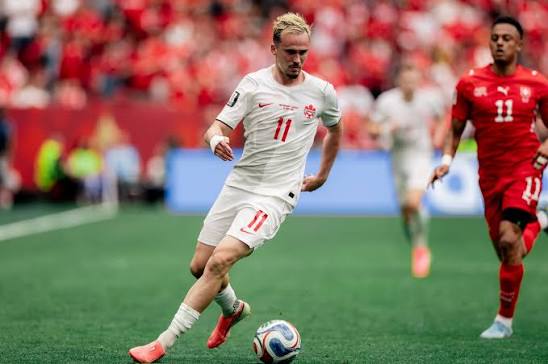
Canada’s men’s national team faces the United States on Tuesday in what should be the most emotionally charged CONCACAF fixture of this international window. After two matches already in the break — including a gritty, divisive win over Chile — Canada heads into this one riding cohesion and momentum, against an American side whose young talent pool just dismantled Mexico. The question isn’t whether this game matters. It does. The question is what kind of game Canada needs it to be.
How Deep Is the USA’s Young Talent Pool?
The American depth chart is absurd right now, and there’s no point pretending otherwise. Cavan Sullivan — 17 years old, the youngest goalscorer in USMNT history after netting in a 3–0 friendly win over Mexico — is the latest name, but he’s far from the only one. Sullivan remains on track to join Manchester City in January 2028, and the joke on the podcast was about him “scoring bags of goals for Man City in the fourth division” — a dig at City’s off-pitch troubles rather than the kid’s ability.
Canada’s depth has been debated across every platform imaginable, and the honest assessment is this: it’s good, but the United States is a bigger footballing country. More players in more leagues around the world. The American pipeline is wider and it’s producing at an alarming rate.
That said, there’s something about this Canadian squad right now that pure depth charts don’t capture.
What Is Canada’s Best Starting XI Against the USA?
Here’s our predicted lineup heading into Tuesday:
Larin
Sigur
De Fougerolles
Bombito
Eustáquio
Priso
Saliba
Shaffelburg
Millar
David
Laryea
Millar’s inclusion is the interesting call. After a strong showing in the previous match, there’s a real case for giving him another crack on the flank. Poe is expected to feature as well — and that’s significant. Tuesday would be the biggest international match of his career to date.
As for the Americans? Who knows what Pochettino will do. The options are endless, and some new faces are about to get their introductions.
Did Sebastian Berhalter Really Get Double-Slapped by a Mexican Player?
Yes. Well, sort of.
During the USA-Mexico match, Berhalter pushed a Mexican player. The Mexican player responded by slapping him twice — not a dramatic windup, more of a quick one-two to the face. Berhalter looked around in disbelief, took roughly four minutes to process what happened, and then went to ground.
It was peak CONCACAF. The question it raised was genuinely interesting, though: does the slapper get a red card (hand to face, generally automatic), while Berhalter also picks up a yellow for the delayed embellishment? Because the stagger-and-fall routine after that much of a pause deserves its own booking.
Berhalter, for what it’s worth, is playing extremely well right now. He’s a good player. He’s also now fluent in CONCACAF dark arts, which might be the more important development.
Watch the Clip
Or Hear the Full Episode on Spotify | Apple Podcasts
Why Does Winning Ugly Matter in International Football?
Canada’s win over Chile split opinion. After about 25 or 30 minutes, the match became a disaster to watch — ugly, scrappy, no flow. A lot of people were unhappy with it.
But here’s the thing: you have to win ugly in international football. Period. In tournament play, in friendlies, in windows like this one — ugly wins are still wins. They build something. The Chile result wasn’t pretty, but it was a result, and results compound.
So if Canada wins 1–0 on Tuesday with two red cards and a match that looks like a bar fight? Everyone will be thrilled. Because against the United States, the result is the performance.
Does the Canada-USA Rivalry Need a Nasty Match?
This rivalry is at its peak right now — on and off the pitch — for reasons that don’t need spelling out. From a footballing standpoint, Canada has played the US well in recent years, going back to 2019, but Mexico has been reasserting itself as the Americans’ primary rival during the World Cup cycle.
What Canada needs is a genuinely nasty match. The kind of game where you hate them and they hate you. Maybe it takes a controversial red card. Maybe it takes some shenanigans — a bad challenge, a referee who becomes the enemy, a moment that lives in highlight reels and argument threads for years.
It might even take that in a loss. Because sometimes a loss that establishes the identity of a rivalry is worth more than a quiet win that nobody remembers.
Vitriolic rivalries are good for the game. They’re good for a team’s identity. Canada playing the United States should feel like something is on the line every single time, and right now the fire is there — it just needs fuel.
What Was Canada’s Biggest Match Against the USA?
The 2002 CONCACAF Gold Cup semifinal stands out. On January 30, 2002, Canada vs USA was toe-to-toe for 120 minutes, finishing 0–0 after extra time before the US won 4–2 on penalties. It was tight, it was heated, and it went right to the very end.
Canada went on to beat South Korea 2–1 in the third-place match.
That match had everything this current rivalry needs more of: tension, edge, and the feeling that neither side was willing to give an inch.