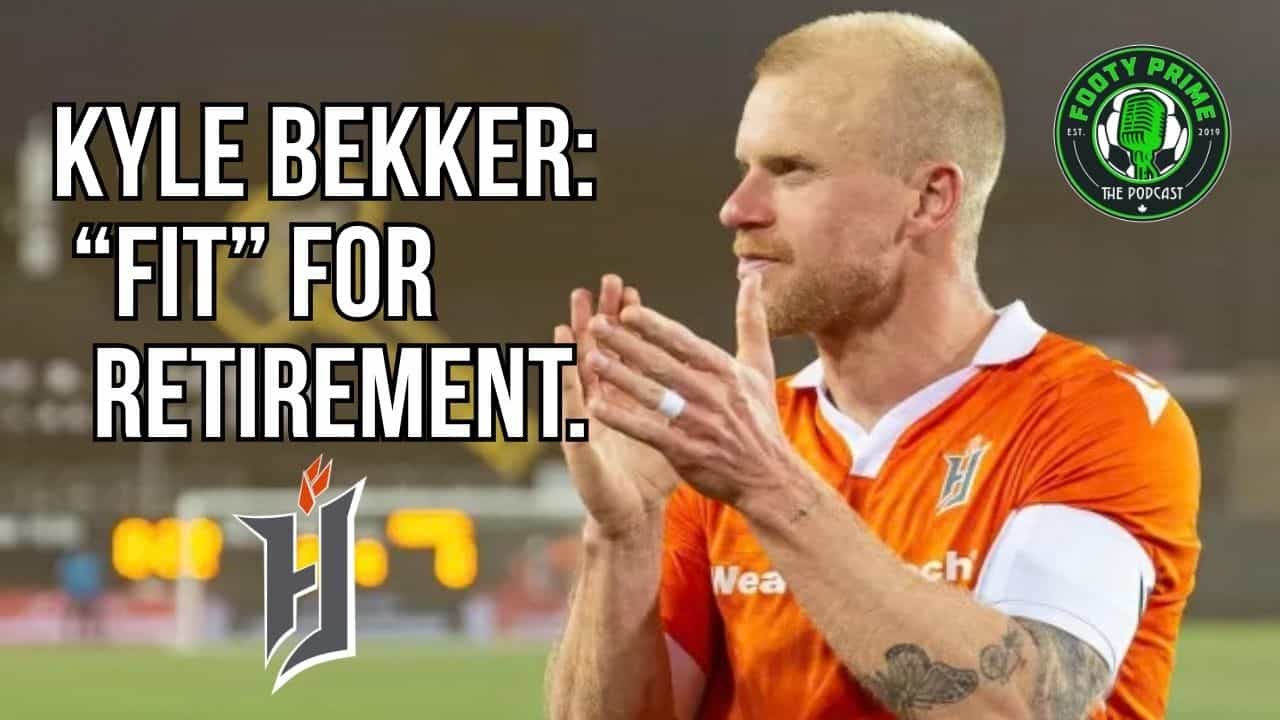
CPL MVP, Forge FC cornerstone, and Canadian Men’s National Team veteran Kyle Bekker retired from professional soccer this week at 36. The day after the announcement, he joined Footy Prime to talk about it: the cancer diagnosis, the knee that finally gave out, the decision he’d already made before either happened, and where his head is at now that the boots are off for good.
How Did Kyle Bekker Feel the Day After Retiring?
Less than 24 hours removed from one of the bigger moments of his career, Bekker described it simply as overwhelming and he meant that in the best way.
“The outpouring of support from the Hamilton community, from the soccer community is more than I could ever have asked for. It’s crazy. You come to the end and you start thinking about all this stuff and every single moment flashes by.”
He said he made a conscious effort not to spiral in either direction.
“I tried to be present in that moment and not get too high, not get too low. And I think that’s just sort of how I am as a person. So it was truly special for myself and my family.”
The Dream That Started on a Piece of Paper Under His Parents’ Roof
Going through boxes at his parents’ house a few years back, Bekker found a booklet from when he was around 10 or 11 years old, one of those team things where kids write down what they want to be when they grow up. His answer: play professional soccer and represent the national team.
He grew up in a country that, at the time, offered almost no pathway to make that happen.
“For a lot of guys, you’re in the desert. You’re just a crazy kid with a dream in a country that didn’t have any of the infrastructure that we have today. There was no pipeline. It was just a hope and a prayer to go out on your own and make something happen.”
He got there anyway.
“To look back and say that I was able to do something that I loved every single day, to have been able to represent my country at the highest level, it’s a joke to be honest.”
Not a complaint. A genuine, slightly disbelieving acknowledgment that it all worked out.
Watch the Clip
Or Hear the Full Episode on Spotify | Apple Podcasts
How Did a Cancer Diagnosis and a Knee Injury Factor Into His Decision to Retire?
This is where Bekker’s account gets interesting. The assumption might be that one or both of those things forced his hand, but he says that’s not quite right.
“The funny part about all of it is this decision was made before that diagnosis, before my knee gave out, all those little things. So I think those obstacles become a little easier almost to deal with because I’m not against the gun to get back.”
He had already told the club at the start of the season that this was likely his last run. So when the cancer diagnosis came, and then the knee, the mental shift was different than it would have been earlier in his career.
“When it happens when you’re a young kid, your whole career flashes. You’re like, am I even going to be able to do this? Am I getting cut short? Am I going to be given the opportunity to do this? So everyone who plays this game, everyone who’s a professional athlete, this is part of it, it’s like the fine print. You don’t want to read it, but you know it’s a reality. It can happen to anyone.”
He joked on the show the day before that he was going to go until the wheels fell off. As he put it to us: they did not get much more off than that.
“I’m fortunate at this club we have incredible resources and I’ve worked a lot with some doctors, a lot of acupuncture stuff, and I remember seeing this one specialist and he literally was like, you’re driving a car and you have zero suspension.”
Is Kyle Bekker Done with Forge FC?
Not even close. He made clear he has no intention of quietly fading out.
“The reason for the announcement was almost to just get it out of the way. I didn’t want this thing to be looming into the end of the season. And it was just a chance to do it, acknowledge it, and then make sure the focus is on the guys.”
Since the injury, he’s been in every day, doing whatever prehab he can, staying present in the group, playing a different kind of role.
“Selfishly it helps me, but also it’s just, it can look different, but I can play a role. It’s a different role for sure, but we still got a lot of stuff that we’re contending for. So if I can do anything to keep these guys in a good mindset, I’m going to do it. I’m a part of this team. I’m a player on this team. I know it looks different, but I’m still here.”
What Does Kyle Bekker Want to Do Next?
Coaching is on the table. Media is on the table. But what’s actually caught his attention?
“The thing right now that really has my attention is sort of like the management side of things. Not necessarily being a coach, but how to build the culture, create that group, find the team, find the pieces that work with it. But then also on another side, where we are in the CPL, being invested in Forge, how do we make a bigger connection to the community? How do we really grab the attention of everyone here?”
That community piece isn’t abstract for him. He’s spent years playing in Hamilton. He’s seen what happens when you put a club in a soccer-mad city that previously had to take the train down to Toronto to catch a live game.
“You put something in their own backyard and they’re just going to follow it blindly.”
What Does Kyle Bekker Think the CPL Needs to Grow?
The 2026 World Cup, hosted on Canadian soil, changed something in how Canadians relate to the game. Bekker noticed it.
“For the first time in a very long time, you saw people being like, ‘Oh, I actually want to be Canadian first in terms of this game.’ And for me, that’s so exciting.”
He drew the contrast with how he grew up, when the Canadian identity in soccer was essentially nonexistent, and kids from immigrant families defaulted to cheering for the national teams of their parents’ countries, not Canada’s.
“Because Canada was such a, essentially, just a nothing thing at that time, we didn’t have that identity. We didn’t have that connection to win in our own backyard, to represent our country, to push the game forward.”
That’s changed. Now the question is how you build on it.
His read on the CPL specifically is clear-eyed. He called it what it is: a startup, eight years in, still finding its footing.
“We have to be patient. We have to be consistent. We have to be persistent. All of these little things. The right people are involved and we’re doing it. The balance is how do you hold that balance of being patient, knowing that we’re doing the right thing, knowing it has to be a slow build so we don’t overextend ourselves and end up in a situation that we’ve seen time and time again in whatever country it is.”
But patience alone won’t get the CPL where it needs to go.
“I do think we need to throw a little gas on the fire.”
Kyle Bekker spent his career being the kind of player who showed up in the moments that mattered; for Forge, for Canada, for Canadian soccer at large. Based on this conversation, the game hasn’t heard the last of him. It just looks a little different now.