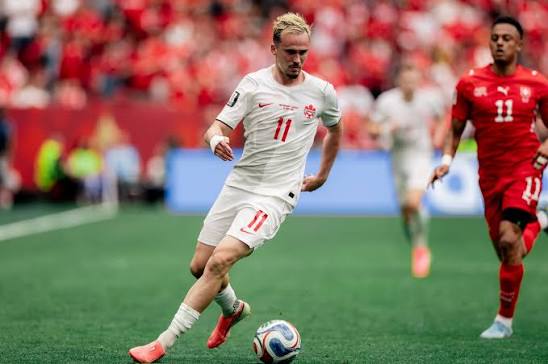

Canadian Men’s National Team head coach Jesse Marsch joined Footy Prime from Baja, Mexico — where he was, in his words, one day away from finally earning a margarita — to break down a chaotic transfer deadline, reflect on a historic World Cup summer, and lay out what the next four-year cycle looks like for Canada Soccer. The short version: playing minutes beat prestige every time, the Morocco match was dominant for 82 minutes (not 45), and Moïse Bombito’s World Cup story is one of the most remarkable things to happen behind the scenes this summer.
Does Jesse Marsch Care Where Canadian Players Land or Just That They Play?
It’s a question worth asking now that Canadians are signing for clubs across the top five European leagues. The answer, if you were wondering, is mostly the latter.
How do you think about player placement during the transfer window, tier of club, or playing time?
“Playing minutes are valuable. Like it’s really difficult when you get guys into camp and they’re not playing — like they’re just not fit enough, they’re not sharp enough — and then their ability to really help us specifically in the small windows… Obviously there are always exceptions and we do everything we can to get the most out of every window, but playing for me is a premium even if the level is a little bit lower than what your personal level is or what your expectation for yourself is.”
Marsch added that he actively uses his relationships with European clubs and coaches to advocate for Canadian players — not just to get them through the door, but to make sure the people making decisions understand who they actually are.
“I’ve talked to people at all those different clubs about all those players and tried to make sure that in a real positive way they understand what their values are and who they are as people — and hopefully that will help them specifically with the coaches, because I have relationships with a lot of these coaches.”
The counter-argument — that a spot on a Premier League bench beats 90 minutes in the Championship — is one he’s thought through. And his experience at Leeds, fighting relegation, informs it.
“The challenges that come along with fighting relegation are stresses I don’t wish upon my worst enemies.”
Liam Millar’s Move to Birmingham City: What Marsch Really Thinks
The storyline of Liam Millar scoring for Hull City against Coventry — a performance that looked like a statement, a plea — landed differently once the loan to Birmingham City was confirmed. Millar already knew he was leaving when he scored that goal. Marsch had known for about a week.
Were you surprised by any of the transfers, did anyone jump out?
“I heard about Birmingham probably about a week ago. So, even before Liam scored, he knew he was probably going out — and Hall made it very difficult for Liam to stay. And so, you know, that’s one of the things that’s so amazing about how he delivered in that situation against Coventry — is that he knew he was leaving.”
Millar’s departure from a freshly promoted Premier League side was always going to sting for some fans. [LINK: previous Footy Prime post on Millar’s Hull City season] But Marsch reframes it quickly.
“If Liam’s just going to sit — if he has the role he has and then he’s coming off the bench and he’s scoring goals, how amazing that would be in the Premier League. But if he’s not going to play in the Premier League, then it’s probably better for him to go to the Championship.”
And Birmingham isn’t just any Championship club.
“Birmingham’s a much bigger club quite honestly than Hull and ambitious to say the very least… Birmingham’s got promotion aspirations of their own. I know it’s loan, but it’s a huge club.”
There’s also the personal side of it. Millar has three daughters. A move means schools, a new city — probably somewhere near Leicester — and uprooting a family that had settled in Hull. Marsch acknowledges it.
“There’s a lot that goes along with it. It’s not just like — and Liam, you know, is familiar, he’s moved a lot, but I think that he really made a name for himself there at Hull and it’s a little bit of a shame that he doesn’t get to continue on this year.”
Jonathan David at Atletico Madrid
After a year at Juventus that never quite clicked, Jonathan David heads to Atletico Madrid and the Simeone system. Marsch likes it.
David didn’t work out at Juventus, do you think Atletico is a better fit?
“I think Johnny can play in any system really and any kind of central attacking role. So even when Juventus tried him in the 10 over the weekend, I thought, yeah, he can do that. Juventus is an interesting club and the number nine position at Juventus comes with big pressure and big expectation.”
On what he told Atletico directly:
“If you’re looking for a guy that will give to Simeone and give to the team and do whatever it takes to help the team win — and have the talent to do the things you need to do at the striker position — this is the guy.”
“I think going to Atletico, Simeone is a coach who gets all these incredibly talented players to really buy into the team system and to give to each other… I think Johnny will fit in there well.”
The Transfer Marsch Is Most Excited About: Nathan Saliba to Villarreal
Put the question to Marsch directly — one transfer, one player, best fit — and the answer isn’t the most high-profile move of the window.
Which transfer do you think makes an immediate impact for the player and for the national team?
“I think that Nathan Saliba has a real chance to establish himself there. They have over the years evaluated — or appreciated — hardworking physical central midfielders. And so the beauty of what I think Nathan has become — and I think that the national team deserves credit for his overall evolution — is he’s not just a technical passing midfielder anymore. He’s now become a physical player that can cover ground, that can win duels, that can win tackles, that can really have a massive presence in the middle of the pitch in the six and the eight.”
The fit, in Marsch’s read, is precise.
“I think Villarreal picked up the exact kind of player that they like and a potential big addition.”
And in terms of readiness to contribute from day one:
“Nathan’s also the kind of guy that like in training he shows every day — when he gets even if he comes off the bench, if he starts, if it’s 60 minutes, if it’s 20 minutes, like he’s ready to physically impose himself in the match in whatever amount of time he needs.”
What Really Happened With Moïse Bombito at the 2026 World Cup
This is the part of the summer that didn’t make the front pages. On May 18th, when Canada’s World Cup preparation officially began, nine of the 26 players Marsch wanted were listed in red — injury doubts, status unknown.
Were you aware of what Moïse was going through during the World Cup? Because from the outside, you wouldn’t have known.
“The World Cup in terms of the injury situation was absurd. On May 18th, we get together and the 26 names that we want — I said this publicly — I wanted to go to camp with 26 players, but we couldn’t because we had nine names on the board in red, which meant: are they going to be ready for the World Cup? Nine out of 26.”
Moïse Bombito‘s situation reached a breaking point that was documented in part on the On Guard series. Marsch had told him at one point he wouldn’t be going.
“Moïse basically at the end — he knew that he wasn’t ready, but at the end he was like — he’s a very religious person and he believed in his ability to speak with God and think about how he wanted to go about the decision process and he didn’t want to give up. He basically came to me and said, ‘Don’t give up on me, coach. Give me every second. Give me every minute. Give me any chance you can.’ And I said, ‘Moy, of course I will.’ Like, because Moïse as a person is even more impressive than Moïse as a player.”
Bombito is now back in surgery — same medical team that handled Ismaël Koné‘s procedure — with the hope that because the bone isn’t actually broken, the recovery timeline will be shorter. Koné remains in Montreal continuing his rehab, showing up at national team matches when he can.
Watch the Clip
Or Hear the Full Episode on Spotify | Apple Podcasts
The Morocco Game: It Was 82 Minutes, Not 45
A piece of revisionist history worth correcting before it calcifies: Canada’s loss to Morocco at the 2026 World Cup is sometimes discussed as a game that slipped away early. Marsch pushes back.
“Literally 82 minutes we were in complete control of that match. And of course at the end then we had to push and we had to make some offensive changes and we had to expose ourselves a little bit more. But look at the game — look at the xG, look at any of the flow of anything you want to look at — for 82 minutes we were dominant.”
The emotion of that result, given everything that had gone into getting there, was something else.
“When we lost to Morocco, it was about how we played, how we got there, the character we showed, the football we showed. It wasn’t about the result at that point — it was about everything else that the team and the group had been through to make sure that in that moment we were ready to go for it. And man, I was so proud — probably more so than any time I had ever been with the Canadian national team — that at that moment, as heartbreaking as it was and as much as we let the game slip, the way we played with everything that we had been through was absolutely extraordinary.”
From the World Cup to the U20s: The Canadian Identity Travels
The day after the World Cup ended, Marsch was on the phone to clubs and agents, building the U20 roster for the championship. He admits that around day two of the tournament he started questioning his own sanity.
What he found, working with a younger group he didn’t know as well, was reassuring.
“The Canadian spirit and the Canadian character is alive and well in all these players, whether they’re 17, 18, or whether they’re 30. The pride that the players have for playing for the national team, the commitment they have to give their best and to know how important it is — and the commitment to the idea of what I’m trying to do with them.”
In three weeks, the U20s looked, in his words, almost identical to the senior team’s identity.
“They looked very similar, almost identical to what we have been establishing with the first team over the last two years.”
The semi-final loss to Mexico — another game Canada dominated and deserved more from — stung. But the takeaway for the program was clear.
How Many U20 Players Will Challenge for the 2030 World Cup?
How many of those U20 players will legitimately be competing for senior spots in four years?
How many of those U20 players will legitimately be competing for senior spots in four years?
“Just based on that group, there’s a lot of guys who I think are intelligent, who are talented, who are committed, that have potential to still grow physically as well as football development and everything else. Obviously it would be wonderful if five or six of those players were challenging for spots in the World Cup in four years — and I don’t see a reason why that can’t be the case, especially missing guys like Kevin Khan and others.”
The next cycle, Marsch is clear, isn’t a reset.
“I’m not looking at this next four-year cycle as a departure from the first two-year cycle. This is a continuation.”
And if there’s one theme he keeps coming back to — more than transfers, more than results — it’s coaching infrastructure.
“Coaching makes a difference at all levels. And when there’s a clear plan and a clear way of executing the plan, that’s going to always help our players develop quicker into the idea of what we want them to become. And so as much as developing the players is important, developing the coaches is more important, really.”
What’s Coming Up: Canada Men’s and Women’s Friendlies This Fall
Canada men host Chile (September 26th, Toronto) and Peru (October 3rd, Montreal). The women host Denmark in a double-header on October 9th and 12th in Montreal and Toronto.
Marsch on what he wants from those camps:
“It’s a continuation, but it’s also — we’re going to honor some of the players. We’ll be introducing some newer, younger players and kind of evaluating how they fit in and where they where to go from here. But I think it’s an opportunity for Canada to show appreciation for the team, for the players, for everything that they accomplished and how they inspired the nation over the summer.”
The party was great. Now let’s see who keeps showing up.