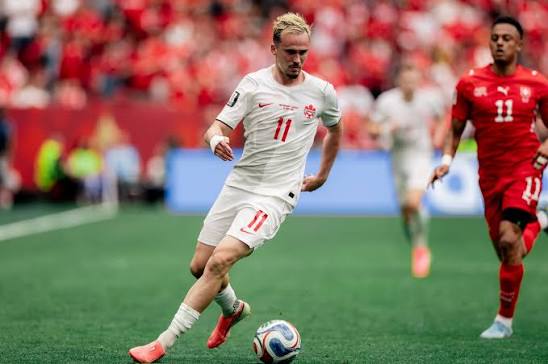

Alistair Johnston joined the Footy Prime crew still carrying a fresh reminder of his last outing, a visible mark from a headbutt that, in his words, should have been a “stonewall red card.” Instead, the referee waved play on despite VAR’s involvement, leaving Johnston baffled about the point of the review system if a clear-cut incident like his could go unpunished.
What stood out most, though, was how he handled it. No theatrics, no rolling around looking for a call, just a brief knee to the turf in the Glasgow heat before playing on. Johnston jokingly admitted a touch more showmanship might have forced the referee’s hand, but staying composed, he said, was simply the more Canadian way to respond.
On Backyard Battles, Hockey Roots and Football’s “Sandpaper”
Johnston traced his combative style back to childhood, growing up as the middle of three brothers in a backyard where games routinely ended in shouting matches and constant physical competition. A hockey background added another layer, he said he always loved the physical side of the sport and carried that same appetite for contact into football, while making a point of tackling clean rather than picking up cards.
That mix of physicality and showmanship, he explained, is exactly what Celtic and Rangers fans respond to. Rather than going down easily, Johnston prefers to get stuck into a challenge, then have a laugh with the crowd afterward. “At the end of the day it is sports, but it’s entertainment,” he said, and as a fullback locked in a battle with an opposing winger, he sees it as his job to give supporters something to enjoy as well as a result.
On Walking Into the Old Firm for the First Time
Johnston’s Old Firm debut came almost by accident. Left out of first-team training all week, he only learned he would start at right back when Celtic’s manager called him in the day before the match, telling him it would be “like a duck to water” after his World Cup summer. He barely had time to process it before finding himself lining up at Ibrox in front of a hostile 55,000 crowd.
He described the atmosphere as unlike anything he had experienced, fans with shirts off, no phones in sight, and a wall of noise directed squarely at the away side. Rather than let it rattle him, Johnston said he simply treated the hostility as background noise and focused on the game in front of him. A late Celtic equalizer, met by bottles and coins raining down on the away end, only sharpened the moment. He called it “a dopamine rush,” and one he has been chasing ever since.
What Celtic vs Rangers Really Means
That first derby result, followed by a treble in his debut season, set the tone for what Johnston now considers the defining feature of Celtic life: European nights under the lights, anthem included, still give him goosebumps just talking about them. Pressed to find a North American comparison, the closest he can get is a college football rivalry game, something like Alabama, but even that falls short once the centuries of history and rivalry behind Celtic and Rangers are factored in.
His advice to anyone trying to understand the rivalry from afar is simple: book a flight, track down a ticket if you can, and experience an Old Firm match in person, because no explanation quite does it justice.
Victor Wanyama’s Seal of Approval
Johnston credited former Canada teammate Victor Wanyama, who knew Celtic from the inside, with pushing him toward the move, not just because of his ability, but because Wanyama understood the personality it takes to survive at a club like Celtic. Success there, Johnston explained, demands a fighter who can handle constant pressure and still enjoy the banter.
The scale of the club hit him almost immediately, fans were greeting him at the airport before he had even kicked a ball. But it was the standard inside the training ground that impressed him most. Unlike MLS, where a salary cap spreads talent more evenly, Celtic’s squad depth meant full internationals were fighting just to make matchday squads. Working daily under Ange Postecoglou and then Brendan Rodgers, he said, has pushed him to find out exactly what his ceiling as a player really is.
From College Center Mid to Celtic Champions League Nights
Once he broke into the side, Johnston said he had no intention of giving it up, fighting through injuries and pouring everything into training for the reward of playing Champions League football and facing Rangers home and away. The connection with Celtic’s supporters, he added, has only deepened since his arrival and remains one of the most special parts of the job.
Looking back at how quickly it all happened still catches him off guard. Just five years ago he was finishing an economics degree and playing center midfield in college, a path he admits “realistically” shouldn’t have led to Celtic and a World Cup. What carried him through years of being overlooked by coaches and provincial programs, he said, was simply a refusal to stop playing and a quiet belief that he was good enough. His father, who works in Canadian football and first introduced him to the sport, still texts him every few weeks in disbelief, something Johnston said keeps him grounded even as the achievements pile up.
Facing Messi and Embracing Jesse Marsch’s New Identity
Johnston pointed out that Canada had not reached the final round of World Cup qualifying in roughly two decades before his generation’s breakthrough, a squad he described as unusually young, with experienced European club players like Alphonso Davies and Jonathan David still relatively new to the international stage. That inexperience, he said, produced a steep but valuable learning curve through the 2022 World Cup cycle.
The arrival of head coach Jesse Marsch, he explained, brought an aggressive, front-foot identity that suited the group’s youth and athleticism perfectly. At Copa America, that approach meant taking the game to Argentina rather than sitting back, even in defeat. “You play Argentina 20 times, it’s not going to go your way 19 of those times,” Johnston said, but he would rather compete on the front foot than concede the game before kickoff.
Building Toward a Home World Cup in 2026
For Johnston, the shift under Marsch is about more than results, it is about changing how Canadians see the national team. A cautious, defensive approach might grind out results, he argued, but it will not convert neutral fans, and Canadian football has long carried a reputation for being slow and low scoring. This summer’s front-foot performances, he said, visibly moved the needle on viewership and public excitement, regardless of the scoreline.
He described the new mentality bluntly: “We’re Canada, let’s go,” with no more pretending to be the underdog. The goal now is to refine that approach so competitive performances start turning into results that “shock the world,” while building momentum both on and off the pitch ahead of a home World Cup in 2026 that the squad hopes will carry the whole country with it.
Watch the Full Interview with Alistair Johnston
Or Hear the Full Episode on Spotify | Apple Podcasts