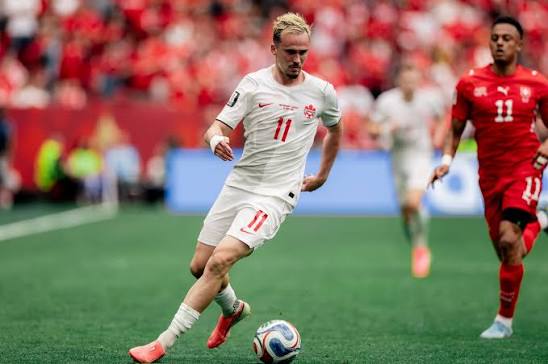

Canada U20 vs Mexico: What Happened in the CONCACAF Semi-Final
Canada’s U20 side was eliminated 2-1 by Mexico in the CONCACAF semi-final, and the real story of the match wasn’t the scoreline, it was a red card. Leo McKenzie, who had scored twice in the quarterfinal, was sent off at the Estadio Azteca for two yellow cards. The dismissal came off a spin move: as McKenzie turned, his hand brushed a Mexican defender’s face, and the referee showed a second yellow.
That set up the rest of the debate: was this a fair call, or another case of Canada being CONCACAF’d?
Was Leo McKenzie’s Red Card Embellishment or a Fair Call?
The panel didn’t dispute the letter of the law, a hand to the face is technically a foul, but argued the real story was the reaction to it: a glancing touch that sent a Mexican player to the ground as if he’d been badly injured.
This can be compared to a near-identical incident against the American U20s days earlier, where a Mexican player went down from minimal contact and was awarded a red card rather than a yellow, with no attempt made to stay upright. What frustrated the panel more was what followed: taunting directed at the Canadian player that drew no card at all. For a team that already dominates CONCACAF at every age group, getting opponents sent off has started to look like part of the playbook, and officials keep letting it work.
Leo McKenzie Red Card Replay: Was There Even Contact?
A closer look at the replay complicated the call further. The stadium itself was part of the story too, roughly 50,000 fans were reportedly inside the Azteca, in a match organizers badly wanted the host nation to win. That frustration deepens once you recall the VAR review of a Canadian penalty shot earlier in the match, in a game Canada already led 1-0, that was waved off; had it stood, Canada would have gone up 2-0.
On the sending-off itself, reads of the replay are blunt: this wasn’t a foul so much as bad luck of positioning. McKenzie’s arm was reportedly already extended as he turned, before the Mexican player arrived in that space, meaning the defender moved into McKenzie’s hand rather than the other way around. It’s a pattern that’s been flagged before: opponents arriving late into contact and hitting the ground immediately.
Is CONCACAF Biased Toward Host Nations Like Mexico?
Pressed on whether this was simple refereeing error or something more systemic, it’s possible we would be naive to think that there wasn’t more to it, an arguement that the pattern has repeated itself too often against Canada to be coincidence. The theory isn’t that referees are told what to do before kickoff, it’s that they understand, without needing to be told, that a Mexico run to the final sells more tickets and fills more seats, and calls tend to bend that way without anyone picking up a phone.
We try to be careful when separating this from the letter of the law: a hand to the face is technically a foul, but nowhere near a bookable one in isolation, and most referees outside a high-stakes CONCACAF final would have found a middle ground. A widely shared tweet from Craig Forest summed up the frustration, joking that getting an opponent sent off has become a “generational talent” while blatant taunting goes unpunished.
What Did Canada Lose by Not Beating Mexico? 2028 Olympics Explained
The stakes went beyond the U20 World Cup spot Canada had already clinched. A win in that semi-final would also have qualified Canada for the 2028 Olympic Games in Los Angeles, a tournament where a Mexico-heavy field on home soil would sell out stadiums easily. You can drew a direct line back to 1994, when Canada was denied by Mexico on the final day of World Cup qualifying despite being level on points, a result shaped by simple commercial reality: Mexico meant more jerseys sold and more revenue for the confederation. No foreign referee has ever been brought in for a match of that magnitude, it’s always been a CONCACAF official calling the game.
Careful to frame this as more than conspiracy, it’s about earned standing within the confederation. Canada’s men’s team is still relatively new to challenging the region’s established powers, and calls tend to follow reputation as much as the rulebook. That was tied to head coach Jesse Marsch’s aggressive, pressing style at U20 level, which racks up fouls, and an odd trend the panel has noticed: once Marsch himself gets booked for pushing back from the touchline, Canada seems to start getting the benefit of the doubt.
Why Doesn’t Canada Get the Benefit of the Referee in CONCACAF?
Nobody on the panel argued Canada is currently the better side. Mexico’s youth teams dominate CONCACAF at every age group and don’t need help from officials to win. Part of the gap is cultural. Canadian players are simply too honest to flop and roll the way Mexican players often do, and that isn’t something that changes overnight.
That set up a familiar tension. Match the gamesmanship to get calls, or hold the line and accept the cost of playing it straight. Diving is everywhere in the world, not just CONCACAF, but look at Gold Cup 2000 and Carlo Corazzin as proof Canadian teams have occasionally played the same game when it suited them. The pattern traces back further still, to the 1984 Los Angeles Olympics, when a Canadian goal was controversially disallowed against Mexico with no clear explanation.
There’s also a structural issue specific to this tournament. Liga MX makes every eligible U20 player available for Mexico, while Canadian and American clubs aren’t obligated to release theirs. Both North American sides went in missing key players against a Mexican squad at full strength.
Men’s World Cup vs Olympics: Which Is the Bigger Prize for Canada?
Adding insult to the loss, after McKenzie’s red card, Mexico won and scored a penalty to close out the match. Canada’s U20s are through to the World Cup even after the loss, just not the Olympics, which raised an obvious question. Given the choice, which tournament matters more? The FP consensus was clear, the World Cup, since only 12 teams make the men’s Olympic football tournament and it simply doesn’t carry the weight on the men’s side that it does for the women’s game.
A wrinkle worth knowing, Olympic men’s football is a U23 competition that allows only two or three overage players, and only once a team has already qualified, part of why the tournament doesn’t carry senior-level weight even when a player like Messi wins gold there. The strongest case for the World Cup comes down to audience. Olympic football reaches a massive general audience, while U20 tournaments mostly stay within the hardcore soccer fanbase, though a deep CONCACAF run, like this one, tends to grow that audience over time.
Watch the Clip
Or Hear the Full Episode on Spotify | Apple Podcasts