Back from a break, straight into FIFA’s biggest mess in years.
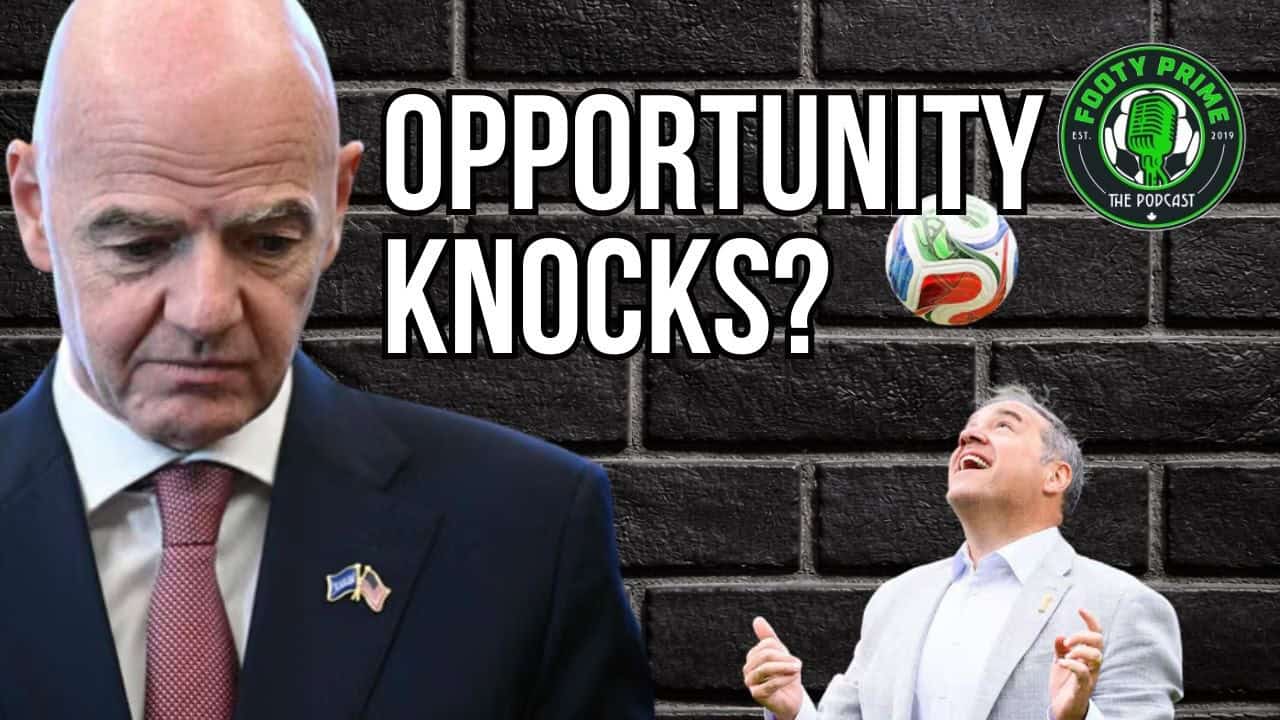
The Footy Prime crew is back after a couple of weeks off, cottages, dead zones, and all, cramming in an extra midweek episode ahead of Wednesday’s regular broadcast because there’s simply too much to cover. Even offline, we couldn’t escape the story dominating football’s group chats: Gianni Infantino‘s proposed shake-up of FIFA’s finances, which seemed to be happening, then not happening, then quietly shelved, all within the space of a couple of weeks. With listeners flooding social media asking for our take, let’s dive straight in.
Gianni Infantino’s pattern of going it alone
What’s striking us isn’t just the specific plan, it’s the pattern behind it. At the centre of the story is a proposal to spin off FIFA’s commercial and World Cup rights into a new company and sell a stake to outside investors, blindsiding UEFA, CONCACAF, and FIFA’s own executive committees in the process. But we argued that this is just the latest in a string of unilateral moves, from a proposed peace prize to in-game hydration breaks, that member federations learned about only after the fact. This time, they say, it was the move too far.
Will Gianni even still be in the job by November?
November is the deadline for candidates to declare whether they’re running against Infantino for the presidency, and one of us doesn’t expect him to have stepped aside by then. The read: Infantino is stubborn and, in one view, operating as though he answers to no one, despite needing sign-off from 211 member associations, the confederations, and the FIFA Council.
He’s reportedly shored up support through deals with Saudi Arabia and Qatar, even as UEFA, the plan’s fiercest critic, declared flatly that “the game’s not for sale,” with CONCACAF and the Asian confederation initially backing that stance too. Whether Infantino survives will depend on whether the confederations and member associations can mount a genuinely united front, with CONCACAF president Victor Montagliani floated as one possible successor.
It’s not a popularity contest, it’s a vote count
Public opinion and media coverage don’t decide this, only the votes of member associations do. And flipping that math quickly isn’t easy: as recently as the Vancouver 2026 bid process, those same associations were firmly behind Infantino. Still, momentum appears to be shifting, with UEFA and CONCACAF reportedly aligned and quietly coalescing around Montagliani as a fallback option, even without a rival candidate emerging from Europe itself. The bigger question we keep circling back to is structural: whatever comes next, should a single FIFA president ever hold this much unchecked authority again?
What is this, the Game of Thrones of sports?
Even FIFA’s own inner circle turned on the plan
The pushback wasn’t confined to rival confederations.
UEFA president Aleksander Čeferin put it plainly: “There’s a growing opposition against FIFA. The World Cup cannot be treated as an investment product.”
More damning still was criticism from inside FIFA’s own building, with the organization’s chief operating officer reportedly describing the plan as a “project of one person” pushed through without consultation. Even senior adviser Carlos Cordeiro is said to have called the privatization push “a bad idea for football.” For a leader who prides himself on control, it’s a remarkable sign of how isolated Infantino has become from his own advisers.
Thanos, Icarus, and a name the plan should’ve had
The internet, predictably, has had a field day. Comparisons to Thanos and his “god mode” mentality, Icarus flying too close to the sun, even a Gollum meme, have all been making the rounds.
The whole scheme could have been called “Project Hubris” from the start, with an argument that arrogance, not strategy, is what ultimately sank it. The reported numbers explain the stakes: JP Morgan is said to have valued the 21% stake in FIFA’s commercial and event assets, World Cup included, at roughly $20 billion. It was Infantino’s own eagerness to talk it up, reportedly deploying FIFA legends and high-profile contacts to build momentum, that caused the plan to leak and ultimately collapse under scrutiny.
The Mean Girls comparison nobody asked for, but that fits anyway
We liken Infantino’s arc to Mean Girls, cast as the outsider finally welcomed into the popular clique, in this case Donald Trump’s circle of American investors, without realizing he’s being pulled somewhere that won’t end well for him. Just as that film ends with its social hierarchy collapsing and everyone forced to find new alliances, we predict a similarly messy reckoning is coming for FIFA’s power structure.
Would the money actually have helped smaller nations, or just Infantino?
Not every argument about this runs one direction. It seems important to note that UEFA has its own commercial self-interest here too, and that the proposed deal reportedly could have funnelled tens of millions of dollars to smaller federations, a genuinely transformative sum for many national programs. But that argument runs headlong into another detail: reports that Infantino himself stood to earn a rumored $30 million salary under a restructured, more commissioner-style role, reportedly inspired by his fixation on what NFL and MLS commissioners earn compared to his current $6 million.
Even setting aside the salary optics, we remain skeptical the promised windfall would trickle down meaningfully to smaller federations at all. With FIFA already projected to bring in an estimated $11 to $14 billion from the most recent World Cup, and ticket prices already out of reach for many ordinary fans, is the sport still being run for the people who love it, or is it drifting toward serving the wealthiest slice of its audience?
Four ways this could end for Infantino
A motion of no confidence would require support from 15% of FIFA’s national member associations at an extraordinary congress.
FIFA’s independent ethics committee could suspend or ban him, a process that would go before the adjudicatory chamber.
He could simply lose the presidential election outright, with candidates needing to declare by November 18, the deadline that puts Victor Montagliani squarely in the conversation.
Or, least likely, he could resign voluntarily.
That last option looks especially unlikely given his actual statement withdrawing the plan, which contained no apology. Infantino said only that he’d “listened carefully to all the views” and that the project had “created divisions of a nature that are no longer in the interest of the objective set out in the first place.” Meanwhile, just over a week earlier, he’d posted a 15-slide Instagram statement celebrating the World Cup as an “overwhelming success” and suggesting critics should reflect on their own views, framing the backlash itself as the problem.
Watch the Full Clip
Or Hear the Full Episode on Spotify | Apple Podcasts