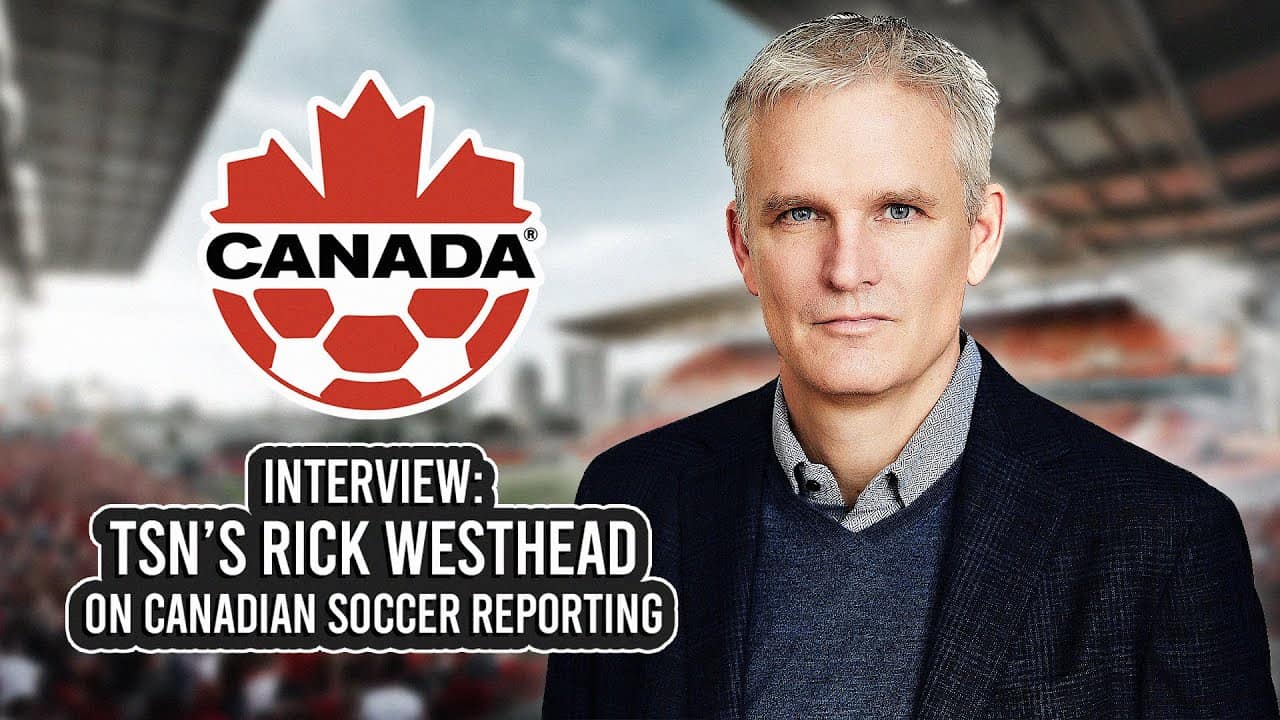
TSN investigative reporter Rick Westhead joined Footy Prime to lay out where the Canada Soccer drone scandal stands, how far back the practice of spying on opponents really goes, and the personal toll of breaking stories that powerful people don’t want told. In a wide-ranging interview, Westhead revealed that close to a dozen sources have come forward in just five days, read a disturbing firsthand account from a young contractor pressured into filming closed US training sessions, and explained why, despite everything, he believes Canada Soccer’s new leadership has an opportunity to rebuild the federation’s integrity heading into the 2026 World Cup.
How Did Rick Westhead Go From Sports Writing to Investigative Journalism?
Before the Canada Soccer files and drone gate, before Hockey Canada and Kyle Beach, Rick Westhead was a traditional sports writer asking athletes how they felt after games. That changed when he decided the work wasn’t fulfilling enough.
“I reinvented myself, became a foreign correspondent for the Toronto Star, moved overseas for years, lived in India, covered Afghanistan on the ground, covered insurgencies in Pakistan and civil wars in countries like Haiti. I was in Japan during the tsunami and I can remember an editor, I was a couple miles from the Fukushima nuclear reactor and people were thinking that’s going to melt down and blow up, and I can remember my editor with the Star saying to me like do you have your affairs in order.”
Ten years ago, TSN brought him over to do journalism on the sports side, and the investigative work followed. But Westhead says the features are actually what he loves most: TSN Originals stories on Alphonso Davies, Jonathan David, Kamal Miller, and on the women’s side, Jordan Huitema and Quinn.
“These stories, they’re uncomfortable truths, they have to be told. And I think what kind of gets lost along the way is often this is just me giving players a voice.”
When the women’s team threatened to strike at the SheBelieves Cup, Westhead wasn’t taking a side. He was giving Christine Sinclair and Janine Beckie a platform to explain their grievances with the federation. The same principle applied to men’s team players and the CSB deal.
Does Rick Westhead Give Canada Soccer a Chance to Respond?
One of the recurring criticisms is that Westhead’s reporting comes from one angle. He addressed that directly.
“In the last 24 hours I’ve gone to Canada Soccer, multiple times, explaining what I’ve been told, what evidence I have to corroborate what I’ve been told, the questions that I have for them. I’ll say, listen, work with me. How much time do you think you need to get back to me with a fair response? And it might mean that we don’t do a story for a couple days, but that’s fine.”
The process doesn’t stop there. Editors read every word and challenge him on it, and TSN’s legal team reviews every story before publication, often suggesting changes.
“The work is vetted. We’re very careful. And even still, that’s not to say that we’re perfect. I’m sure if you look back at reporting over the last years you could say well what about this paragraph where you said that, and I bet there’s a few instances where I’d say now looking back yeah I wish I had more context for that or I wish I’d elaborated on that a little bit more. But we do our best.”
Does TSN Have a Conflict of Interest in Reporting on Canada Soccer?
As a rights holder that broadcasts Canadian soccer, TSN faces questions about whether it has a vested interest in its own reporting. Westhead’s answer: look at the track record.
“Anyone who follows Canadian sports knows how important the World Juniors Hockey Championship is to TSN. Well our reporting in 2022 led to that tournament being cancelled and led to the brand of Hockey Canada being tarnished. I’m not sure it has come back yet. That was reporting on our largest partner, our most important partner.”
He also pointed to TSN’s story about Toronto Argonauts quarterback Chad Kelly being accused of sexual harassment: “Again our partner. Chad Kelly actually has worked on TSN as an analyst. So I think if you look at the body of work there’s enough there that proves to people that we’ll go wherever the story takes us.”
Has Westhead ever been told to avoid a story? Yes, once, at the Toronto Star, where an editor steered him away from something that didn’t align with advertiser interests. At TSN? Never.
“At TSN in the last 10 years no one has ever ever said to me don’t do that story, it’s not in our interests. It’s always been make sure you’re right, make sure you’re fair, do your job.”
Watch the Clip
What Surprised Rick Westhead Most About Drone Gate?
The sheer recklessness of it.
“Imagine thinking it would be okay to get on a flight to France with the drone. After, like, you don’t have to read every story to know how serious the security situation is in France right now. And to fly a drone in restricted airspace at least twice. Remarkable.”
Westhead also raised questions about how Joey Lombardi, the analyst who was arrested and spent three days in a French jail before being convicted and given an eight-month suspended sentence, has been treated.
“Joey Lombardi, all I’ve heard from him, about him from people, is what a solid person he is, what a good person he is. And it makes me wonder, like, this guy spent three days in jail in France before he was convicted, given an 8-month suspended sentence and sent home to Canada. I don’t know if he’s ever going to be able to travel internationally again. But I wonder, like, did anyone visit him when he was in jail for three days? The people who have been in charge of this, have they reached out to him? Are they going to be accountable? There’s just so many questions.”
Did Canada’s Players Know About the Spying?
Westhead has reported that men’s national team players saw video of Honduras’s closed training. That’s as far as the reporting has gone. At the Olympics, every player has said they didn’t know.
But the question is whether that’s enough. If game strategy was informed by coaches who had information they shouldn’t have had, the players are part of that program whether they knew or not. And that’s where it gets complicated for FIFA, particularly if the governing body decides to look back at the 2021 Olympics and other tournaments.
The Contractor’s Story: “I Was So Deeply Uncomfortable”
One of the most striking moments in the interview was Westhead reading a firsthand account from a former Canada Soccer contractor who was involved in spying in 2017. The contractor was a university student working as an analyst in Vancouver when a coach gave them a camcorder and told them to infiltrate a closed US team practice.
“The coach told me we can’t go because if they catch us we’ll be in trouble, but you can go and if they catch you you can just say you’re a student, like just a random person. So they gave me a camcorder, the kind of mom would take to record her kids’ game, and sent me off telling me to get some footage of their formations. I found a vantage point and filmed two US practices. But the footage we acquired was so awful because I was shaking the whole time and you can hear me hyperventilating.”
“I was so deeply uncomfortable. I was on these missions and I was being told that if I really wanted to work in women’s football, if I really wanted to have a career, that this was the kind of tough stuff that you have to do. I was so desperately trying to break into this mysterious and competitive industry and I didn’t think about what was right or wrong. I just wanted to impress these powerful people.”
That account exposes a power dynamic that goes beyond any single incident of drone use. A 21-year-old wearing the crest, excited to finally have a job with a national federation, being told this is what it takes to have a career in the sport.
Will the Canada Soccer Scandal Go Away?
Internationally, possibly. Westhead noted that a very popular UK-based podcast addressed drone gate at the top of their show but got several factual errors wrong. The international media doesn’t know the full story.
Domestically, no chance.
“Think about what Canada Soccer is going to be obligated to do with pressure because of its sponsors who want to be associated with this brand. You have to feel for the sponsors, right? Imagine being a company and sinking hundreds of thousands of dollars into this brand over the last couple years. You must just be, if you’re a marketing manager, you must be shaking your head thinking, like, are you kidding me.”
Canada Soccer has hired an employment lawyer in Toronto to conduct an independent external review and has promised to make the results public without editing them before publication.
“In five days I’ve heard from close to a dozen sources on this story. People who have left the program, contractors, employees. Every time I get out of the water or out of a boat there’s another message from somebody saying hey so and so told me to talk to you, or I’d like to share with you what my experience at Canada Soccer has been like.”
Is “Everyone Does It” a Valid Defense?
The “everybody does it” argument has been everywhere since the scandal broke. Westhead put it in perspective with an analogy to Russia’s state-sponsored doping program.
“In 2014, 10 years ago, when Russia had this state-sanctioned doping program where they were literally handing bottles of dirty urine and blood through a hole in the wall and swapping them out for clean so they didn’t get caught, well, they got caught. And more than a dozen Russians won medals in those Olympics and what happened when they got caught, they were expelled from international sports for at least four years. So there’s consequences when you do it.”
Westhead was clear he isn’t putting drones on the same level as doping. The point is simpler: when you get caught, there’s a price, even if others are doing it too. And Bev Priestman publicly stating that all the top 10 teams do it is only going to put a bigger target on Canada’s back.
The parent test works here too. If your seven or eight year old comes home from school having just gotten in trouble and says “well everybody was doing it,” nobody’s response is “do it more.”
What Is the Personal Cost of This Kind of Reporting?
Westhead was honest about what the social media backlash has done to him, drawing a line back to his reporting on Kyle Beach and Hockey Canada, when people were “wishing my kids ill will” and “saying horrible things.” The drone gate fallout brought those feelings back.
“My job at TSN does not require me to use social media. I don’t get paid more and I don’t value my own worth or my work more if I have 20,000 or 50,000 followers or 500 followers or whatever. So to me it’s an easy call. There’s no obligation to be on there in the first place. There’s definitely no obligation to have to take stuff like that. So just block it and move on.”
He shared a small detail that stuck: he was at a friend’s cottage the previous weekend with eight adults. Of the eight, only one was on Twitter. Him.
“Another reminder, like, Twitter is not real life.”
Why Are Sources Afraid to Use Their Names?
Westhead always encourages sources to go on the record because named quotes carry more credibility. But he doesn’t pressure anyone. The courage it takes to reach out in the first place is significant.
“Imagine that you come forward and think I’m going to do this because it’s the right thing to do. I put my name out there because I know it adds more credibility. What do you guys think the reaction would be?”
The fear is real: blowback, lawsuits, career consequences. In Canadian soccer, a small industry with limited jobs, being a whistleblower is a risk. And the anonymity doesn’t mean Westhead is operating alone. His editing team and TSN’s lawyers know every source.
Can Canada Soccer’s New Leadership Fix This?
Westhead sees a clear opportunity for Kevin Blue and Peter Augruso.
“Kevin Blue and Peter have an opportunity here. They can actually come out of this being known as the people who help to restore the integrity of a federation. So for them it’s an opportunity.”
The new leadership didn’t create this mess. This scandal predates them. But how they handle the investigation, and how transparent the findings are, will define whether Canada Soccer enters the 2026 World Cup on solid footing or still dragging the fallout behind it.
“As crazy as it sounds right now, I’m actually optimistic about where this will wind up a year from now. I think it’ll be in better shape than it is now.”
That board has largely turned over. There’s more scrutiny on the federation now than at any point in its history, from media, from government, and from the sponsors writing the checks. Whether that pressure produces real accountability remains to be seen. But the tools are there.
Rick Westhead is a senior correspondent at TSN. You can follow his reporting at TSN.ca.
Footy Prime is available on YouTube, Spotify, and Apple Podcasts.