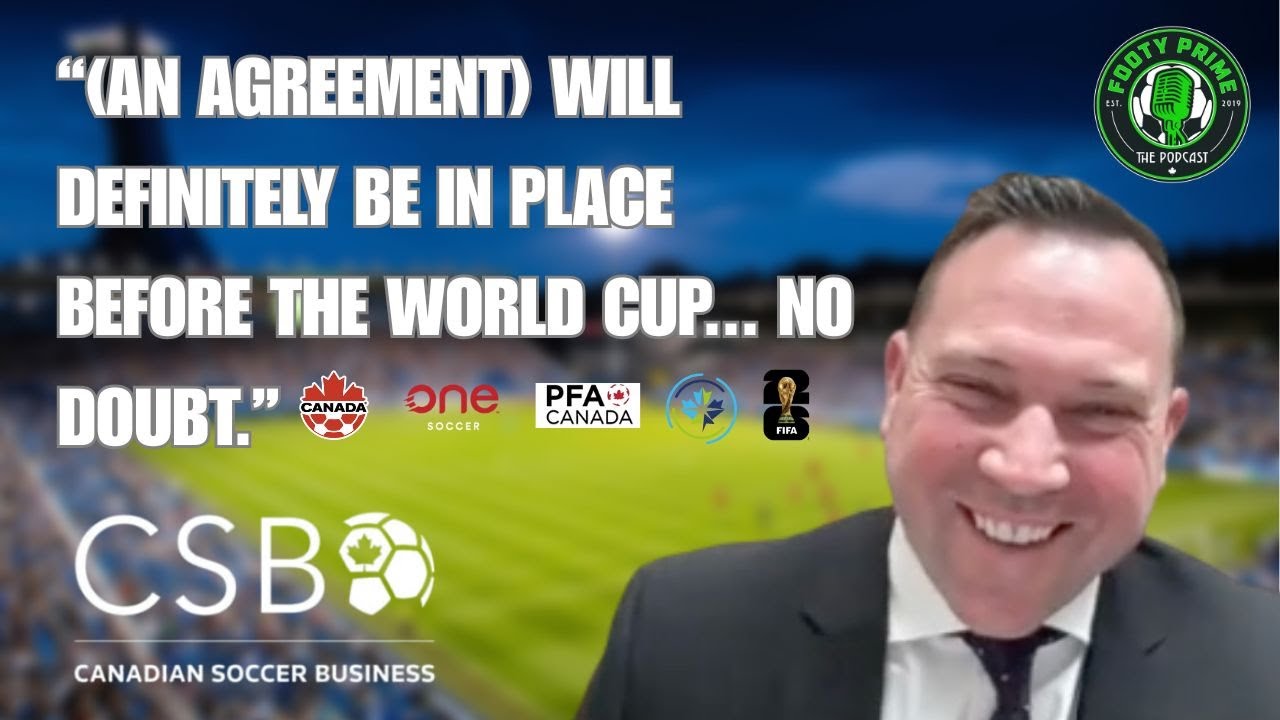
Recently, Footy Prime welcomed Canada Soccer Business CEO James Johnson to the pod. Just six months on the job, James talked candidly to us about the long delayed Canada Soccer agreement, whether linear carriage for OneSoccer is close at hand plus is Valour FC officially a dead franchise?
Here we go.
So James, we actually met a few months ago at a media roundtable when you first took the job and actually you asked most of the questions which is quite refreshing as you’re trying to figure out the lay of the land in Canadian soccer circles. Have you figured it out now? Does it all make sense to you?
I think it’s important to ask questions, particularly when you’re the new kid on the block. I think good leadership is really about understanding challenges before you’re proposing solutions so that roundtable was important. It was important for me to ask questions and not come in with assumptions.
That was really what I focused on in the first three to four months. It was speaking to different people within the industry both in Canada and also abroad and trying to really find patterns around challenges. I call it a discovery phase.
We’re sort of approaching the six month mark now and we’re in that transition from discovery into how do we set ourselves up to be in a great position going forward in 2026. How do we set ourselves up organizationally but also how do we contribute to a broader ecosystem system with a lot of people doing a lot of great things to make 2026 such a great year for the sport.
Did you find or have you found that there’s a similarity between Australia and Canada in many ways and the synergies?
Yes, there are so many similarities. Like in Canada, soccer is the biggest participant sport in the country. The A League and the W League are a little bit older than obviously the Canadian Premier League (CPL) and the Northern Super League (NSL), but not that much older. We’re talking 10, 15 years older and so they’re still quite new. The national teams though are similar.
I think the great news for Canada is the women’s team has been so strong for so many years and the men’s team now is a great team. I don’t think Australia’s there yet to be candid.
I think Australia’s done very well given the teams they’ve had over the past six to eight years but I think that’s actually an opportunity for Canada that Australia doesn’t have because you’ve got teams that can literally go into tournaments now and win and I think that is important.
When you’ve got two great national teams that are in the forefront and they’ve broken into mainstream, which I hope we can contribute to doing over 2026 and 2027, I think that’s really where the sport comes together and really helps the whole sport grow, including participation.
Speaking to Mark Schwartz in DC, he was talking that he thought there were some similarities between Canada and Australia as far as the powers to be and that although Australia is football’s number one participation, it gets suppressed somewhat because of the people and the powers that push Australian rules, football for example and rugby, and it’s difficult ultimately to get ahead there. And he thinks that maybe it was similar here with hockey. Do you agree with that?
Yeah, I think I do. And look, I know Schwarzy very well and I’m sure you guys probably played against each other, Craig.
(Yeah, we did. Yeah. 93)
I think that is a fair assessment by Schwarzy and I’ve had many conversations with him over the years. I always felt and I’m putting my former job hat on at the moment and then I’ll come back to Canada. I always felt that you’ve got to play to your strengths and in the Australian landscape you’ve got sports like in Canada, like the AFL, like the NRL, that are top tier men’s professional leagues and people follow them week in week out and it’s very engaging.
What I always felt the opportunity was with Australia was that Football Australia could really help lift the level and the brand of the women’s national team which was unique. And that happened over the past five, six years and through the Women’s World Cup. And really start getting a cross-pollination of fans that were supporting historically the men’s national team and also the women’s national team.
And Australian football really grew. It grew quickly because when you’re able to have two great teams that are playing two, three matches every sort of six to eight weeks, you get double the content and you can create engagement that continues and continues and continues. When you can overlay that with good performances on the pitch, particularly when teams are playing on home soil, it can really elevate the sport against other sports.
I really see that opportunity here. Like as I said, great women’s team that will play in 2027 in Brazil in the same time zone. That’s a huge opportunity. Netflix has now taken the broadcast rights. We own the rights until then. How do we create a win-win so we can help boost the women’s national team visibility.
Then obviously next year, we’ve got the men’s World Cup. This is going to be something that Planet FIFA comes to Canada. We’ve never hosted a men’s senior World Cup. We’ve hosted obviously a women’s senior World Cup. But that’s just going to lift the level. And if we can be prepared collectively to make sure that we provide a platform for the players in 2026 and then 2027 I think it’s going to be great and I think we’ll be competitive against other sports.
That Australian comparison is interesting. It does seem that over the years though Australia’s been backed by the government more so than perhaps Canada. Is that a challenge for us here still that we have to rely perhaps in the private sector more so than other countries?
I’m still learning the ropes on that question but I would say this. I am a little bit concerned at the pace that the legacy conversations are happening here. I want to be really honest about that. We still have six months and that’s great but I think what we’ll see is as we get closer to the World Cup, we have the March windows, and then the kickoff for the World Cup,
I think the expectation not of just the government, the football community, but the community in general will really be, “well, that’s great. We’ve got this huge event that we’re all enjoying, but what is a legacy?” And I think we need to be collectively ready to have that conversation and have an ask for government because there’s going to be a lot of pressure for government to deliver for football and for soccer of course in the country.
In the Australian experience, the government support is a new thing. If we were having this conversation eight or nine years ago, the government support for soccer was very small. I think the key change was the ability of the Australian Federation to start talking the language of government and really trying to find ways to understand the policy of the government, what was important for the government and the community and being able to tailor the asks to help support the objectives of the government. And I think that’s really important with government engagement.
The NSL (Northern Super League) just got a really big boost injection of funds from the government that’s earmarked for just over $5 million. Is that part of your long-term strategy at the helm of CSB (Canadian Soccer Business) and CPL to create that legacy there where you have soccer specific builds in Canada?
Yes is the short answer but there is a caveat to it. I thought that was awesome for the NSL, what an achievement after just a year of playing. And I think that was a really strong message from the government. Full applause to the NSL. That was awesome.
I think the way for us to do it is to go collectively as a sport to the government. There is a lot of alignment that we can get. I know Canada Soccer is working together with the NSL, with us and also with FIFA Canada. That’s a great start because I think from a government perspective if you’ve got all these different asks coming in you don’t want to be making choices and standing on landmines. What’s needed is just a collective voice, a well-coordinated realistic ask.
Grants and funding for soccer specific stadiums for the NSL, that is equally important for the CPL. The chances are we’re going to be wanting to play in the same markets. What we want are great stadiums so that our fans, whether they’re watching the women’s game or the men’s game, have great experiences. And that’s going to be a legacy of the World Cup. I think the coordination and the alignment is going to be important in our locking government funding.
How would you say the relationship between CSB and Canada Soccer right now is?
If I listed out the top two or three priorities as the incoming CEO, the relationship with Canada Soccer has been my number one priority. There’s logic to that. One, I know there’s a lot of history and that history needs to remain history and we need to draw a line and move forward. That means we need a new agreement and we’ve been working on that and we’re in a great spot. We’re not there yet, but we’re not too far off.
If I park the agreement for a moment, you can write anything you want down on a piece of paper. What’s important is the spirit of the agreement and the culture around the agreement. A big focus of mine, and it has been reciprocated by Canada Soccer and Kevin Blue during the period I’ve been here, has really been to build a trusting relationship where we can work and see ourselves as partners.
I don’t think there’s been any negativity. There’s been no negative media comments over the past six or so months. Everything that’s come out of our offices or Canada Soccer has been positive and that’s reflective from what’s going on on the ground. I speak to Kevin daily. We’re working through different challenges. We’re trying to support Canada Soccer as much as we can and that’s being reciprocated. That will set ourselves up culturally once we knock the new agreement together.
Do you think it’s important that an agreement is in place before the World Cup? Is that your goal?
It will definitely be in place before the World Cup without doubt, yes. I’m hoping it’s much earlier than the World Cup but we’ve got to get comfortable with the final bits and pieces of the agreement.
Let’s imagine we’re going into 2026 and we’re in early 2026 and we have a new agreement. Canada Soccer then has the respective CBA agreements with the players and we’re working together with a government ask ahead of a men’s World Cup. Then 12 months later, we have a women’s World Cup in Brazil. It’s this golden window at the moment. I think it’s important for all stakeholders to make sure that we’re ready to go as early as possible in 2026.
Where are we at with OneSoccer and getting a linear license?
We’re waiting for a mediation through the CRTC. I’m the kind of person that that’s going to happen when that happens and I’m hoping that happens very shortly. In the meantime, we’ve got to move forward and be pragmatic.
Our focus has been to increase our level of content offer. That’s why we recently acquired the Bundesliga rights. There was logic behind that. It wasn’t just so Canadian fans could watch Bundesliga soccer. Fans can watch Alphonso week in week out as he re-enters the pitch for Bayern Munich and we’re going to do a lot of shoulder programming around that because it’s a pretty cool concept to watch the captain leading up to the World Cup.
We’re also focused on other content. We’re looking at leagues, women and men in different parts of the world where we can acquire rights and bring them together so fans can go to one place to watch soccer. Our priority is leagues, men and women, where Canadian national teams are playing. You’ll see more acquisitions for CSB to put on OneSoccer.
Valour FC suspended operations. Does that mean there’s a potential suitor down the road for the Winnipeg outfit?
I think sometimes you have to take one step back to go two steps forward. With Winnipeg, we needed some time to get set up better. We needed a new ownership group and a stadium solution. The stadium Valour was playing at wasn’t soccer specific and wasn’t right for the stage they were at.
I went out there to listen. I spoke with the community, the fans, the ownership group. I went to the stadium. I drew the conclusion that it was the right time to pull the plug, but for a short term. It’s a great market. People love soccer in the community. There’s high participation. What we need is a new ownership group and a stadium solution.
I hope we can work with the NSL over time to find a solution because I know that’s a market the NSL would like to be in as well. I think that’s where good strategic collaboration can occur.
You’re a smart guy, you’ve been around the football block around the world and you wouldn’t just jump at any job. What was the reason that really allured you towards this burgeoning soccer market that’s still in its infancy?
I was the CEO of Football Australia for five and a half years. Before that, I worked at FIFA for many years where my job was to grow professional football in many countries around the world. I’m passionate about football being number one around the world. We are number one in most countries but not number one in major countries.
Canada is a big country. It’s a top 10 economy of the world. I’m really excited and I believe in the opportunity and what’s ahead for Canadian Soccer.
In countries where you have high participation, the next generation loves the sport. They play it week in and week out. That’s happening here. In countries where leagues are developing at the professional level, that can develop players for the senior national teams, we’ve got great leagues that are the start of their journey, the CPL and the NSL.
Then we have the LeagueOnes under that developing the talent. Players for the men’s and women’s national teams have come out of League1 and that’s exciting. Here in Canada, you have two world class national teams and I think being able to bring that together at a time where we will host the world’s biggest sporting event provides a platform for quick growth.
I want to be part of that and I want to contribute to that. Canada deserves to be in a position where it is a top nation. That’s why I’m here.
Do you really believe that soccer can be mainstream in Canada?
Absolutely. I wouldn’t be here if I didn’t. I wake up every morning as a British Australian wanting to ensure that Canadian soccer is mainstream and I’m working very hard to do that here.
Are you watching the Ashes? Where’s your allegiance?
[Laughs] Not watching it, but keeping up with the results. I’ll stop there.
Are you heading back to Australia for Christmas?
I’m not. I’m going to stay in Toronto, enjoy a white Christmas with family and try to get a few things done. I want to make sure we’re ready to hit the ground in 2026. That’s the commitment I’ve made to my organization. I feel if I fly 24 hours, sitting on the beach and enjoy BBQs in the evening, I might disconnect and it’s not the right time.
Watch the Full Episode
Or Listen on Spotify | Apple Podcasts