
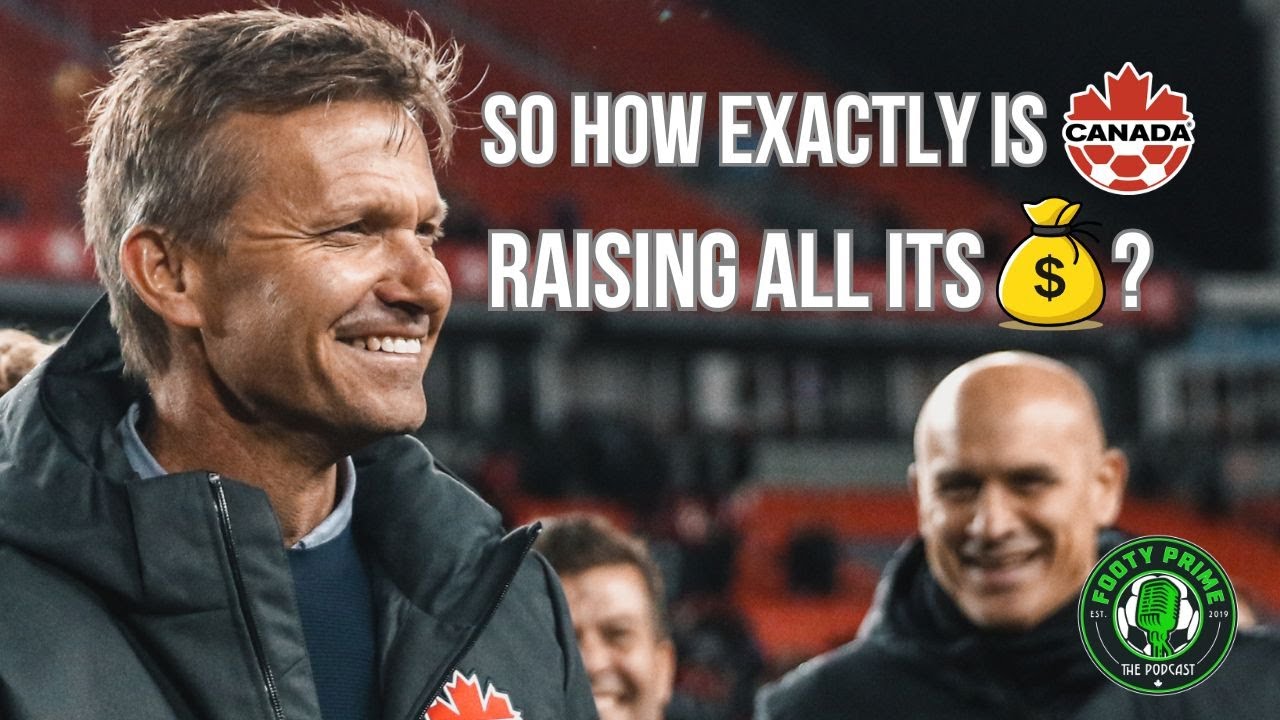
In this interview, Footy Prime welcomed Samantha Rogers, VP of Philanthropy at Canada Soccer, who discusses the Federations new approach to fundraising, alumni relations and details CanadaRED and Canada Rising.
[Sharman] Canada Soccer Foundation, Canada Rising, CanadaRED, basically all philanthropy as a means to raise funds for Canada soccer. Are you surprised by the response within Canada so far?
I think it’s so exciting, for sure. I don’t want to say I’m surprised, but sport philanthropy is still so new in Canada. So, I think it’s been really incredible to see the uptick for sure and how Canadians have come together and supported soccer in the country. That’s been really fun to watch in such a short amount of time, too, which has been incredible.
[Forrest] I look back to the John Herman time and raising money and it was like, okay, is this the world we’re living in now? We used to sort of sit back and wait for our governments to sort of help out and never would, not in our opinion anyway, and is this something that is going to be continued and how important is it for our programs to raise money these days as it as opposed to the way it used to be with basically nothing.
And I think it’s been easy to look at other countries too in what they do. And so if you look at someone similar to us in Australia, they have in the past few years actually started shifting where the government is starting to look at them and say if you’re not going to generate your own revenue, we can’t just keep giving you taxpayer dollars. So you have to be able to prove that you can do it yourself with all revenue streams, not just philanthropy, of course. But what I find really interesting with them is they have a model. They’re with an Australian sports foundation and they’re on track to raise about 100 million just this year.
That’s a game changer and obviously we’re not quite there yet, but the goals that you’ve set for 2026 and and beyond would you say you’re well on the way to reaching those goals?
Yes. So our goal is to raise 25 million. Canada Rising is our philanthropic campaign to raise 25 million by the end of 2027 and we have just hit the 15 million mark which is really really very exciting and it’s almost overwhelming to see the support that we’ve had.
[Wonger] You’re VP of Philanthropy at Canada Soccer, did that exist before Kevin Blue came in and how did you get about moving into this position? And just FYI before you came on I told everyone out there in podcastland about how well you did at McGill. So some of those parallels from McGill now over to Canada Soccer. Can you describe some of them and how you’re getting over the challenges?
For sure. So I think when, and thank you Wonger for saying that, but when I was at McGill that was really new right and so even a lot of the athletic departments at our Canadian universities weren’t even really looking to raise funds. It wasn’t something that was maybe as prestigious as other departments like medicine or business and things like that.
But when you look at the passion and the support that lives within athletics, it’s really easy to bring people together. And so a lot of it at McGill was really about establishing a base where we know people are passionate about whichever sport. So we know people are passionate about a sport. We know people are passionate about their time there, their teammates, their community, all of the experiences that they got out of sport. So how do we harness that?
And whether it’s people giving back 50 bucks or giving back their time because we know sport is really built on the backs of volunteers. But no matter what way we look at it, there’s always a different way to give back. So really it was just about harnessing that all and bringing it together.
And so when I left McGill, I ended up working with a number of different federations trying to build a similar platform where it’s like, hey, you have this incredible community and people are really passionate about it. So how do we turn that into like a really single impact area that we can actually build some sustainability into the sport?
And so now seeing that at soccer, it’s been really quite fun to try to establish that. I always look to our neighbors to the south, US Soccer and and the way that they’ve built out their foundation, and they have someone in a similar role as my as mine, and we talk a lot because it’s a very unique role to be in within the football space, obviously, especially at a time like right now, but it’s been it’s been a really fun challenge and I really enjoy working with people in this space and the community.
And I always say I have the privilege of meeting all these incredible people who are just looking to make an impact and my job is to help them make that impact in whichever way they see fit.
[Walsh] I got to see you in Montreal when our Men’s National Team was playing Australia at Saputo and you just talked about our neighbours to the south in the US and they’ve always done this in a really innovative way and we seem to be late to the party in that regard. But you visited the US and how do you tap into that experiential aspect of it where you give people the kind of lived experience right up close to the pitch, on the pitch with the armbands and all that sort of stuff with the wristbands, the accessibility to the players. Like that’s the CanadaRED experience that I think we’re just new to. So how do you grow that and what was that experience like kind of tailing your US counterparts and like what they’ve leveraged so far in the way that they’re fundraising?
It’s funny you say that. Even when I was at McGill, it’s really when I started to get a peek behind the curtain at just college athletics in the US and what they do in terms of bringing people behind the ropes and giving them the experience you just mentioned. And so it was a natural fit of course with Canada Soccer, calling US Soccer and saying, “Hey, do you mind if we come down and shadow you?” And they are completely open to it. They say, you know, steal any ideas that we have. Let’s share. Let’s learn from each other. We’re competitors on the pitch, but we’re not competitors in the work that we’re trying to do here.
So, we went down to Columbus just to really see exactly how they put that on and be able to learn from them in different ways like how do we bring people in.
It’s really important for us to also show everyone that’s behind the team. So, not just the players and the coaches, but who is all of the staff that’s making things go round and how do we let people have some insight into Spencer, our equipment guy, and what he does and his passion and making sure that everyone is prepared, right? And in communications and what are all the different sorts of background things that we sort of take advantage of on a day-day-by-day basis, but we know that a lot of people are really interested in joining that journey with us and being there and having that exposure.
And I think what’s really important with what we’re trying to do is create access, opportunity, and excellence. So, how do we bring everyone along with us for that opportunity as well?
[Forrest] The alumni is something that’s been sort of talked about behind the scenes, putting that together for Canada Soccer. What role do you see that playing and how can they better the situation for you and make things easier and how can they affect things in more positive way moving forward?
I think what’s been really nice to see is having alumni involved in a number of different things whether it’s looking at hiring new coaches, some of the work that we’ve been trying to do on the ground, making sure that our current players know all of our alumni.
So, just when the men’s team were in Toronto, Jesse had an open training session for all the alumni to come back. I think whatever opportunity it looks like, sport welcomes alumni in so many different ways. Being able to be on the sidelines, supporting us, giving back, working collaboratively and just trying to build those relationships as we go is what’s really important.
[Sharman] The CanadaRED program is essentially the fans’ opportunity to kind of give back. Has that had a great response, a good response? Do you expect an uptick once the new year turns into that World Cup year?
We’ve just crossed the 2 million mark last week, which was really really incredible to see.
As we move forward, what I really hope is that people don’t see this just as a World Cup opportunity, that it’s really something that is long-term and it’s meant to impact the sport and it’s meant to grow the sport. And so for us, our responsibility is to ensure that people understand the impact that it’s having.
I think people, no matter what level they choose that works for them, I think there’s also a sense of pride in knowing that the funds are going back to one of our three impact pillars. And so it’s really important for us to be able to show them what that means and what that impact has had.
I think so long as we keep showing that impact and bringing them along for the ride and welcoming them into everything, there is something there said about wanting to be a part of that sustainable model moving forward. And hopefully it continues to grow as we go and as we go into the women’s world cup in 2027 as well.
It’s been a really great opportunity to have this runway for us to jump into this and want to keep that moving forward.
[Sharman] Using the World Cup next year as the big leverage for this moving forward, but the minute that final is played on July 19th, do you just switch your gears to the Women’s World Cup in 2027? That’s the new lever you’re going to use?
Yes, CanadaRED is meant to mimic almost like an annual fund. And so ideally, it’s this annual membership that you continue to contribute. And so even in non-World Cup years, hopefully that there’s still enough interest and that we deliver enough value and you see enough impact that even on those non-World Cup years that you would still be involved with the program.
[Wonger] What’s the difference between Canada Rising and CanadaRED?
Canada Rising is really just our rallying cry. It’s our foundation brand spot around this philanthropic campaign. And so, typically in the philanthropic space, you’ll launch a campaign and a campaign has a theme and a and a title.
And so Canada Rising is our $25 million philanthropic campaign and that’s brought in support through the foundation, support through CanadaRED. So, it encompasses everything that we’re trying to do from a philanthropic standpoint.
[Walsh] I was going to ask how you convince Canadians where I think sport usually takes a backseat to a lot of things and Craig mentioned the fact that the government doesn’t really back sport as much and so now we’re turning to private citizens and trying to lean on Canadians to back it in that sense. So how do you convince rich citizens but also everyday Canadians that sport is a cause worthy of support?
It’s my favourite cause.
It’s a tough sell because, in my experience, people have always thought and assumed, oh, well, athletes are rich, so you know, you’re overflowing with money. Nobody needs money. The system is perfect. And they don’t necessarily look at the different opportunities that exist.
It was always strange to me that you can support your local museum, your local church, your local community program, but you can’t support a local soccer club. It doesn’t make sense in that same way.
But I think a lot of it comes down to the education and our first big hurdle was actually educating people that you can contribute to sport. You can contribute to Canada Soccer and actually get a tax receipt. It is a philanthropic contribution. That was a first big hurdle of ours.
But then once we got there then it was actually understanding the impact. So then where does all of that money go and how do we actually grow it?
What I said earlier is that I get I have the privilege of seeing behind the scenes these different individuals that that come along, whether it’s a $2 million donation because they’re just really passionate about fixing something in the sport or it’s a $50 donation because that actually does matter and people don’t think that that matters, but $50 buys a ball. Like, we actually can move the needle with a small contribution.
I would never want anyone to think that it’s just sort of a needle in a haystack and it doesn’t actually move the dial, but it really does. And I think collaboratively to see Canadians come together and wanting to to move that forward has been really inspirational.
But a lot of it is just talking. I think we’ve had donors who have come forward even just from the behind the scenes tour and they’re sort of putting things together and understanding oh okay all of this goes into making us a successful program so where can I contribute or you know they’ll pick something up that Jesse said where well how come the guys couldn’t have a camp, because they don’t have the money, so how much does a camp cost, how do we actually move that along and where can I contribute. There is that level of sophistication from donors that just pick up on things that become of interest to them and then just saying, okay, how do I solve that for you?
[Sharman] Obviously with the ticket pricing controversy, a lot of people don’t quite understand that that is out of Canada Soccer’s hands. They don’t have much say in that at all, but has there been pushback to you when you promote CanadaRED for example and the opportunity to get tickets through that program and then the pricing therefore?
We certainly have a lot of inbound on tickets and I think some people were not fully understanding the process of how it works and so of course you can join CanadaRED for free and there will be tickets available in that tier but then of course it changes the game. Once you make it through and then you see what the ticket prices are, which has we have nothing to do with and we have no control over, and I think it will price certain people out.
I think for us what we’re trying to do is ensure that there’s enough opportunities around the World Cup that people still feel like they’re included, whether it’s watch parties, community initiatives, support through our club plus program, whatever we can do from a federation to be able to provide as much opportunity and and for our clubs and our community to take advantage of the World Cup where we can.
Watch the Full Episode
Or Listen on Spotify | Apple Podcasts